Nexus Rehab Occupational Therapy PLLC helps outpatient clinics build structured, efficient, and sustainable OT service lines so more patients can access the functional rehabilitation services they need.

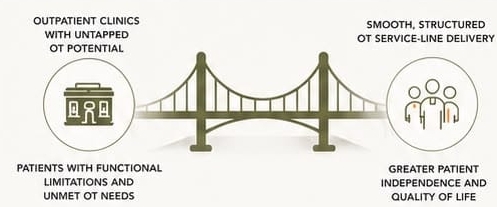
Nexus Rehab Occupational Therapy is the bridge between outpatient clinics with untapped OT potential and patients that strive to regain independence and quality of life.
Many clinics serve patients who could benefit from occupational therapy, but OT services are often limited by staffing challenges, cost concerns, supervision requirements, documentation needs, and uncertainty around patient volume. Nexus Rehab Occupational Therapy PLLC was created to help solve that gap.

Occupational therapy is not just another service line. It is the discipline that helps people return to daily life.
Nexus Rehab Occupational Therapy PLLC exists to make occupational therapy more accessible, operationally feasible, and sustainable for outpatient clinics – so more patients can receive the functional care they need to move better, live safer, manage pain, and participate more fully in daily life.
A Model Designed to Grow With Real Patient Volume
Nexus Rehab Occupational Therapy PLLC is built around a practical, pitch-based model designed to help clinics test OT demand, evaluate workflow, and expand services based on real patient volume. This allows clinics to begin with focused OTR/L roles, assess OT referral patterns, determine whether COTA coverage is justified, and scale the OT service line in a controlled, efficient way. The goal is not to force a one-size-fits-all staffing model. The goal is to build the right OT structure around the clinic's actual needs.


Nexus Rehab Occupational Therapy PLLC is led by an occupational therapist with experience across multiple settings and patient populations, including adult rehabilitation, geriatrics, CVA-related functional deficits, orthopedic conditions, upper extremity limitations, pain-related dysfunction, and ADL/IADL independence.
This background provides firsthand understanding of what OT can accomplish when patients receive skilled, functional, and goal-directed care. It also provides strategic insight into what clinics need in order to deliver OT services safely, supervise staff confidently, document standards, workflow support, communication, and ongoing clinical oversight.
OT services should be guided by appropriate clinical reasoning, supervision, and treatment progression.
The focus of OT should remain on meaningful daily function, independence, safety, and quality of life.
OT services should be structured to meet the clinic’s needs with appropriate COTA support.
Documentation should clearly reflect skilled care, functional goals, progress, and clinical decision-making.
More clinics should be able to offer OT services without being limited by inefficient staffing models or unclear operational structures.
A strong OT service line. depends on clear. communication between the OTR, OTA, clinic leadership. and care team.